

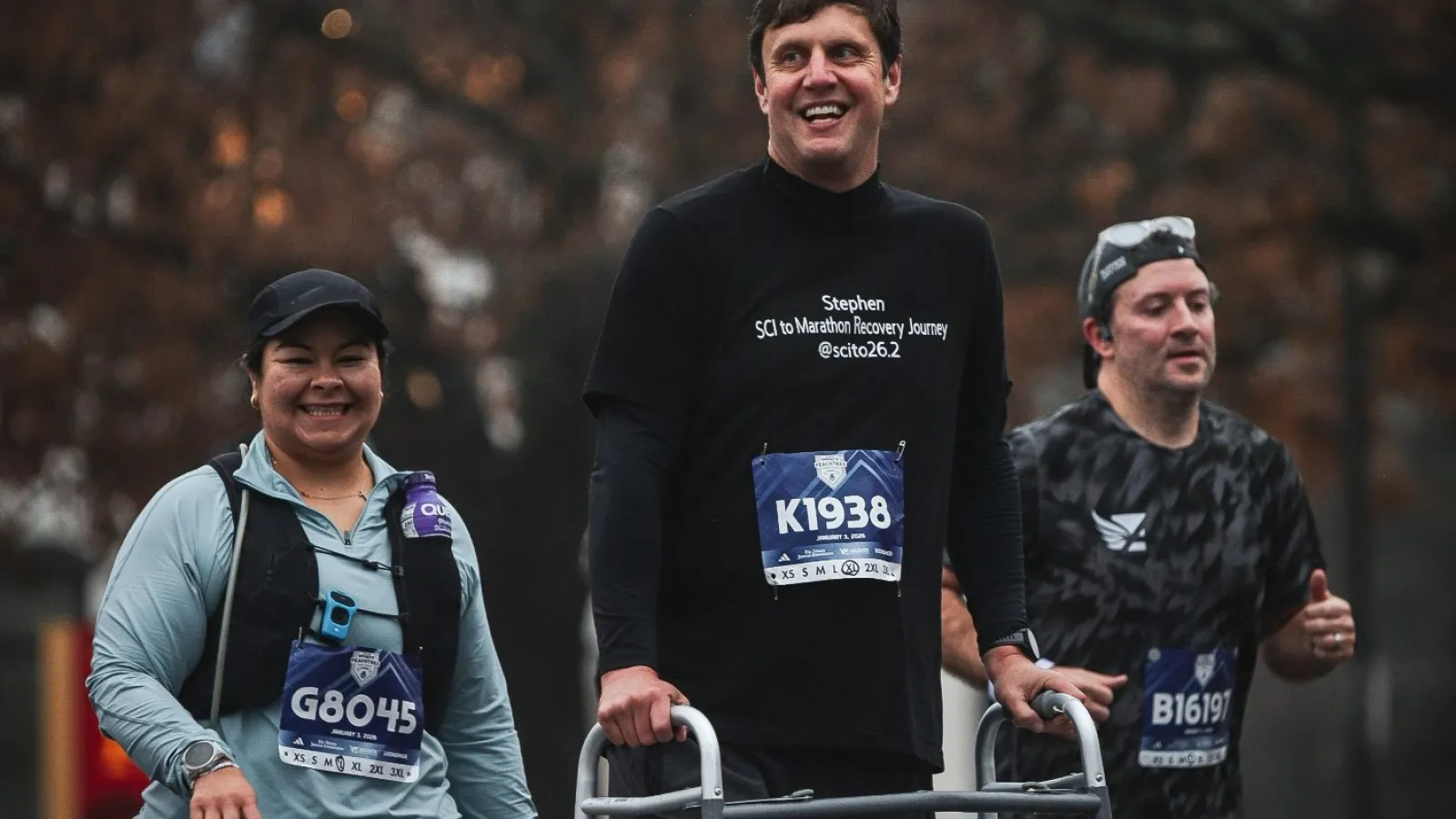
From 5 Percent to the Finish Line: Stephen Peterson’s Comeback After Spinal Injury
On Jan. 3, 2026, Stephen Peterson placed his walker on the start line by Piedmont Park for the Polar Opposite Peachtree Road Race - three hours before thousands of other participants began their own race.
Over the next five hours, the 48-year-old moved steadily toward Lenox Square, cheered on by waves of passing runners and walkers. Alongside him the entire way was his friend Laura Martinez. At the finish line, spectators and race finishers lined the sidewalk to applaud every final step.
"It was amazing," Peterson said. "People were cheering me on, I was cheering them on. We were all just grateful to be out there."
Crossing the finish line marked far more than a race result. It was a milestone in a journey that began last May, after Peterson sustained a spinal cord injury in a fall that he now describes as a turning point in his relationship with alcohol.
The injury fractured a vertebra and required emergency surgery, followed by six weeks at Vanderbilt and nearly three months at Shepherd Center in Atlanta. Surgeons fused his spine and told his family there was a slim chance he would ever walk again.
"They told my sister that there was a 5 percent chance," Peterson said. "But I've always had that running mindset that made me want to keep pushing. I wanted to make [that 5 percent] happen."
Running had been a part of Peterson's life since 2012, when he completed his first half marathon and "became addicted to it." Between 2012 and 2018, he ran 10 half marathons, often logging miles around Atlanta. Over time, those miles faded as his focus shifted away from the sport.
In 2023, Peterson began returning to running and attending local run clubs with Martinez, who he now calls "an angel in his recovery."
After his injury, Peterson was determined to defy odds and get back to racing, and to sobriety.
"Since I've gone sober, I'm more present with my family, I sleep better, I have more energy," he said. "There are so many good things that came out of the pain. The trauma became a reset."
He approached rehabilitation like a training cycle. On July 4, while still in a bed at Shepherd Center, he watched coverage of the Peachtree Road Race and set a goal: to be part of it the following year. By late July, he left the hospital in a wheelchair. A month later, he could stand and take steps with a walker.
Today, Peterson trains four days a week at a recovery center, focusing on active-based therapy, gait work and strength training. On weekends, he logs miles on the Atlanta Beltline or Alpharetta Greenway moving steadily with his walker.
By December, seven months after his injury, Peterson and Martinez traveled to San Antonio for a half marathon they registered for before his fall. Race organizers allowed him to start early. Fourteen hours later, he crossed the finish line.
Three weeks after that, Peterson completed 6.2 miles at the Polar Opposite Peachtree. The course took him past Shepherd Center, where he had once watched runners from a hospital bed. He now hopes to return for the Peachtree Road Race on July 4.
Peterson began his race early that morning with the Club's support, giving him the time he needed to complete the course. While the official finish line had been packed up, staff and supporters were there to welcome him as he arrived at Lenox Square, a finish line in spirit, if not in structure.
Peterson's injury and reset brought him a new purpose: to help others. He shares his recovery journey on social media, documenting both progress and setbacks.
"If I can inspire someone in sobriety or mobility recovery, then what I'm doing makes sense," he said. "Sharing my story has been cathartic—if I can give someone else a glimpse of hope, that's everything."
He credits Martinez, his family, his physical therapists and the running community for supporting his progress.
"Walking these races with him teaches me more than I can put into words about determination, grit and God's grace," Martinez said. "To see him from day one at Shepherd to where he is now is honestly unbelievable. Stephen has carried himself with so much humility through it all... and I'm deeply honored to have walked alongside him through this journey."
Looking ahead, Peterson hopes to complete a marathon one day. More immediately, he wants to continue encouraging others facing setbacks, whether from injury, illness or other life circumstances.
"Mindset is everything," he said. "Even on days you don't feel well, keep working out. Keep training and set a high goal. If you can't run it, walk it. If you can't walk it, crawl it. No matter what, you can push through limitations, and it gets better."